The artist places himself within the family story. The Crucible asks what it means to receive an inheritance of memories and to give it a form of one’s own.
Between Athens and New York, the self-portrait becomes a meeting point for different times and places. The past is neither set aside nor repeated unchanged. It is worked through in the act of making.
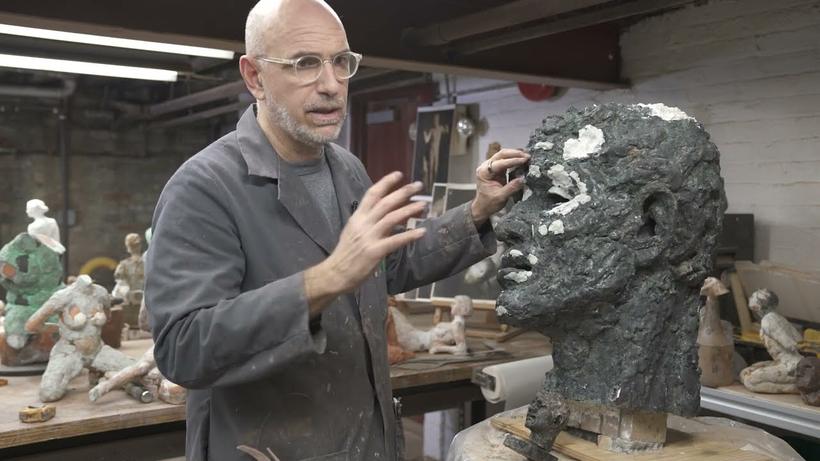
The uneven surface keeps that effort visible. Rather than offering a settled image of the self, the sculpture allows tension and uncertainty to remain. Its transformation is material and artistic, not a promise that history can simply be resolved.
A crucible is a vessel in which materials are heated and transformed. Here the title suggests the artist working with inherited memories and turning them into sculpture.
- Model
- George Petrides · born 1964
- Value
- Culture and well-being
- Materials
- Recycled PETG, printed at large scale, reworked by hand, and finished with metal coatings and patinas.
- Dimensions
- 91 × 55 cm · height × diameter
- Completed
- 2024 · Version II
Views and details
Sculptural reference
Auguste Rodin, Pierre de Wissant · The Burghers of Calais
Rodin’s treatment of Pierre de Wissant offered a precedent for a head that conveys an inner struggle. Petrides draws on that expressive intensity while making the portrait his own.
In the artist’s words
George Petrides · edited from the original artist’s account.
Rodin is one of my favourite sculptors, and I already knew The Burghers of Calais well. For this project, I concentrated on the head of Pierre de Wissant.
Sculptural inspiration — read more
Rodin’s group recalls the six citizens who offered themselves during the siege of Calais. The original account follows his studies for Pierre de Wissant, from a questioning gesture directed towards himself to a more defensive movement. That movement between hesitation and resistance helps explain the choice of this expressive head.
Sources in the original account
- Wikipedia contributors. (April 12, 2022). The Burghers of Calais. In Wikipedia, The Free Encyclopedia. Retrieved July 24, 2022.
- Wikipedia contributors. (September 26, 2021). Pierre de Wiessant. In Wikipedia, The Free Encyclopedia. Retrieved July 24, 2022.
Historical film
Watch the English-language film on YouTube.
Historical context
Modern Greece, part II · Modernization, crisis and renewal
Historical chapter from the exhibition catalogue, arranged here for the family story in Sulala.
The late 1990s and early 2000s were characterised by accelerated modernization. Economic growth increased, new enterprises were founded, and urban areas saw improvements in transport, telecommunications, and public amenities. The decision to host the 2004 Olympic Games in Athens concentrated these trends. The Games drove the construction and renovation of sports facilities, the expansion of metro and tram lines, major road projects, and upgrades to airport and urban services, while offering a visible platform for contemporary Greek architecture, design, and performance.
The global financial crisis of 2008 and its aftermath posed a severe test. The 2010s brought pronounced economic contraction, high unemployment, and intense debate about debt, reform, and social cohesion. Once again, many young people left for opportunities abroad, reviving long-standing patterns of mobility. At the same time, new forms of initiative appeared: cooperative ventures, social solidarity structures, start-ups, and cultural projects emerged alongside established businesses. Public institutions undertook difficult reforms. By the end of the decade, macroeconomic indicators had improved and a more sustainable fiscal framework was in place, even as the social impact of the crisis continued to be addressed.
In these same years, Greece was positioned at the forefront of wider regional developments. Conflicts and instability in neighbouring areas brought large numbers of refugees and migrants across the Aegean and into mainland Greece. Local communities, volunteers, non-governmental organisations, and public authorities organised reception and support under often challenging circumstances. The widely circulated images—of island shores, temporary camps, and rescue operations—were underpinned by numerous acts of routine assistance and cooperation that became part of the country’s contemporary self-understanding.
The COVID-19 pandemic added another layer of pressure. As elsewhere, authorities and citizens faced the dual task of protecting public health and maintaining social and economic activity. Health professionals and administrators reorganised services, while schools, universities, and workplaces shifted rapidly to remote operation where possible. The period accelerated digitalisation in both public administration and the private sector and reinforced the perceived importance of resilient health systems, clear public communication, and mutual support.
In the early twenty-first century, Greece continues to balance continuity and change. Traditional pillars of the economy—tourism, shipping, and agriculture—remain central, while sectors such as information technology, renewable energy, logistics, and the creative industries are expanding. Universities and research centres participate in international networks, and members of the diaspora contribute through collaborations, investment, and periodic return. Urban districts and rural areas alike have become sites of experiment, where small enterprises, cultural initiatives, and local associations reshape everyday environments.
The challenges ahead include demographic trends, climate change, regional tensions, and the ongoing task of strengthening institutions and broadening opportunity. Greece confronts these issues with resources built over decades: democratic practice, European and regional partnerships, dense cultural capital, and a proven capacity for recovery after crisis. The generation now coming of age inherits memories of hardship alongside concrete examples of resilience, collective organisation, and innovation.
From 1950 to 2025, the trajectory of modern Greece can be seen as one of repeated rebuilding and adjustment: after war and occupation, reconstruction; after dictatorship, a consolidated democracy; after economic crisis, institutional reform and renewed initiative. In Sulala, this history connects the father’s world with the artist’s own experience, and opens the question of what subsequent generations carry forward.
Historical images
Sources and reading
This section is drawn from the catalogue’s Modern Greece chapter (1950–2025). The source chapter does not provide a separate bibliography.