Christos’s life at sea opens the family story to the wider world. The Navigator considers the distance, risk, and responsibility involved in making a living across oceans.
For a merchant sea captain, departure is also work. The father’s portrait brings a different kind of movement into the exhibition: voyages undertaken to build stability for those at home.
The monumental head draws on the visual authority of an imperial portrait. As Petrides worked, the historical model gradually took on his father’s features. Public power becomes a more intimate question of presence, memory, and responsibility.
- Model
- Captain Christos Petrides · 1929–2017
- Value
- Social transformation
- Materials
- Recycled PETG, printed at large scale, reworked by hand, and finished with metal coatings and patinas.
- Dimensions
- 89 × 60 cm · height × diameter
- Completed
- 2024 · Version II
Views and details
Sculptural reference
Colossus of Constantine · Capitoline Museums, Rome
The surviving head of Constantine provided a model of stillness and enlarged scale. In Petrides’s reinterpretation, the distant image of a ruler becomes a remembered father.
In the artist’s words
George Petrides · edited from the original artist’s account.
My study focused on two monumental portraits of Constantine: the surviving head of the Colossus in the Capitoline Museums in Rome, and a marble head in the Metropolitan Museum of Art in New York.
The enlarged eyes and stillness of the Capitoline head interested me as a way of giving a face a presence beyond everyday likeness. The second portrait offered a different treatment of the same imperial subject.
As I developed my interpretation of these works, the imperial figure gradually acquired my father’s features. He died in 2017, but I felt that I had brought something of his nobility and enduring presence into the sculpture.
Sculptural inspiration — read more
The original account compares two portraits of Constantine, rather than treating a single imperial image as the only source. The contrast between formal authority and a remembered father is central: the historical reference becomes personal through the act of modeling.
Sources in the original account
- Wikipedia contributors (July 21, 2022). Colossus of Constantine. In Wikipedia, The Free Encyclopedia. Retrieved July 24, 2022.
Historical film
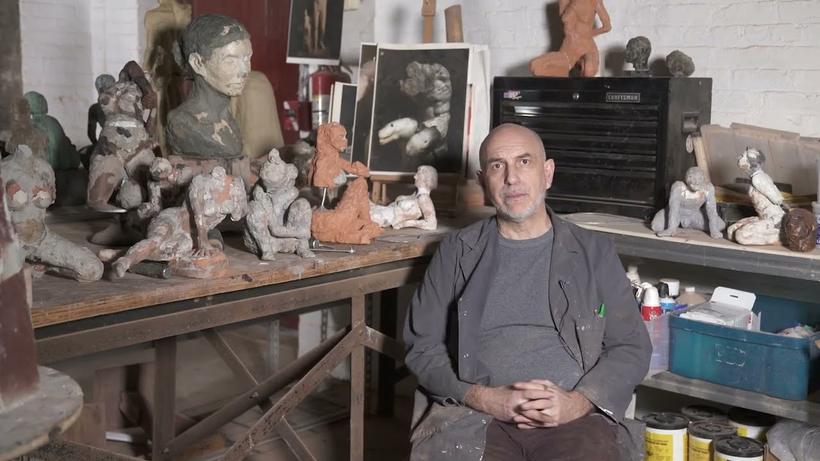
Watch the English-language film on YouTube.
Historical context
Modern Greece, part I · Reconstruction to European membership
Historical chapter from the exhibition catalogue, arranged here for the family story in Sulala.
From the devastation of war and occupation, Greece entered the second half of the twentieth century focused on reconstruction and re-establishing its place in a changing world. Cities and villages bore visible damage, infrastructure was fragile, and many families had been separated or bereaved, yet daily life resumed quickly. In the decades that followed, the country experienced rebuilding and outward migration, dictatorship and the restoration of democracy, integration into European institutions, rapid modernization, economic crisis and recovery, and new roles at the intersection of regional and global developments. Across these shifts, Greek society repeatedly showed an ability to adapt, reform institutions, and invest in future generations.
In the 1950s and early 1960s, reconstruction was visible across the country. Roads and railways were repaired or extended, electricity and telephone networks expanded, and ports and airports were upgraded. Urban centres such as Athens and Thessaloniki saw new apartment blocks and public facilities alter skylines and daily routines. In rural areas, agriculture gradually mechanised, and access to schooling and healthcare improved. Poverty and inequality persisted, but key indicators moved upward: literacy increased, life expectancy rose, and a growing share of young people entered secondary and higher education. A generation that had come of age in war now directed its efforts toward stability and new opportunities for its children.
At the same time, many Greeks sought prospects abroad. From the 1950s onward, hundreds of thousands left for Western Europe, North America, Australia, and other destinations as workers, students, and emigrants. Remittances supported families and local economies, while Greek communities overseas maintained close ties to the homeland. Neighbourhoods, churches, and associations abroad became extensions of village and city life. This outward movement eased pressures on the domestic labour market and created a dispersed but interconnected population whose experience would shape Greek society in subsequent decades.
Political life in the same period combined reform with tension. The 1960s brought expectations of modernization alongside intense polarization, culminating in the 1967 seizure of power by a military junta. Civil liberties were suspended, opponents were exiled or imprisoned, and public expression came under close control. Yet civic and cultural life did not disappear. Students, artists, journalists, and other citizens worked, often at personal risk, to preserve memory and independent thought. When the dictatorship collapsed in 1974, the experience of repression strengthened the commitment to open debate and constitutional procedures and prepared the ground for a more durable democratic order.
The transition known as Metapolitefsi marked a decisive turning point. A new Constitution reaffirmed political freedoms and the rule of law, parties reorganised, and exiles returned. Parliamentary life stabilised, and peaceful transfers of power became routine. The state expanded education, healthcare, and social protection, while new social actors—women’s groups, youth movements, professional associations—entered public discussion. Political competition now took place within a firmly democratic framework, and trust in key institutions deepened as courts, universities, and independent media consolidated their roles.
European integration provided a further framework. Association with the European Communities and full membership in 1981 brought investment in infrastructure, agriculture, and regional development and encouraged legal and administrative reform. It facilitated mobility for students, researchers, and workers and connected Greek public debate to broader European discussions. Europe functioned both as a set of practical arrangements—affecting trade, migration, and regulation— and as a reference point for rights and standards. Within this environment, cultural life was notably active. Literature, music, cinema, theatre, and the visual arts addressed both the legacies of the past and the changes of the present, while archaeological research and museum projects deepened knowledge of the ancient and Byzantine past and tourism brought these heritages into sustained contact with visitors from abroad.
Sources and reading
This section is drawn from the catalogue’s Modern Greece chapter (1950–2025). The source chapter does not provide a separate bibliography.