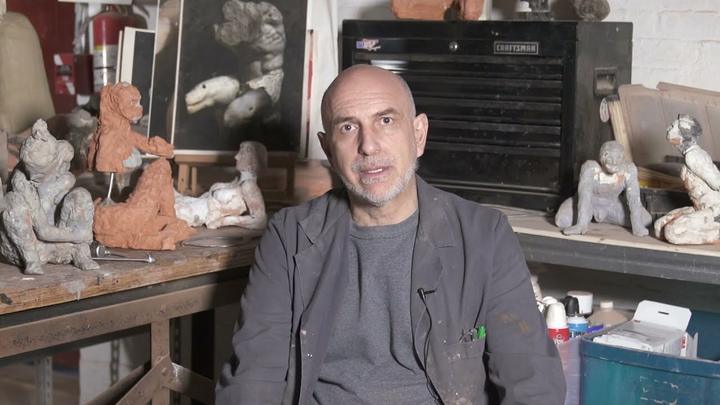
From clay to a finished surface
Lineage of the Future
1. Looking and modelling
The work begins with a person and a sculptural reference. Modelling by hand allows the artist to explore likeness, expression, and the relationships between forms.
2. Scanning and scale
The modelled form is scanned and developed digitally. Changes in scale can be considered before the full-size work is made.
3. Printing in recycled PETG
For this exhibition, the bodies of the busts are fabricated from recycled PETG on a large-format printer designed and built by Petrides Public Sculpture.
4. Returning to the hand
Printing is an intermediate stage. The artist reworks the surface by hand, adding and removing material so that the final work retains the directness of modelling.
5. Colour and surface
Metal coatings are applied, then treated to create the final colour and texture. These surface treatments are called patinas. Digital fabrication and hand finishing work together; a metallic appearance does not mean that the busts are solid bronze.
One portrait, from clay to a finished surface: Thalia
Petrides Public Sculpture brings every stage of making into one studio, from modelling with live sitters to hand finishing, for closer control of quality and time. Digital fabrication and handwork are used together, in a dialogue between the hand and the machine. The steps below follow one portrait, Thalia, modelled on the artist’s mother, from the first question to the reworked print.
I. The question: why
Every work begins with what to make and, more importantly, why. The “why” must be strong enough to give the sculpture its life. Here it was a series of oversize portrait busts based on members of the artist’s family, using live sittings and historical photographs: a way to share history and culture with a wide audience while seeking to understand those closest to him.
II. Research and precedent
Research into ancient Greece, which he studied as a Classics major at Harvard, led back to the great collections of Greek sculpture. As a touchstone he chose a Thalia in the Vatican Museums, which gave the new portrait its name. For the sitter he turned to a black-and-white photograph of his mother in her twenties, taken in post-war Greece. A likeness was not the goal: the aim was a psychological study of a young woman in war-torn Europe.
III. Clay, by hand
Blocks of clay become a bust over days and weeks, covered each night with a wet cloth to keep them workable. The portrait was neither a copy of the Vatican Thalia nor only a likeness. In the artist’s words, it was “image-finding, not image-making”: much changed as he kept reworking the clay.
IV. 3D scan
When the clay had “arrived somewhere”, a 3D scanner recorded its surface as a point cloud, a set of data points in space. Software turned the points into a mesh, a surface of triangles: a digital object that can itself be sculpted.
V. Digital sculpting
In Blender, proportions are refined and alterations that would take a day in clay take seconds. When the model is right, it can be enlarged to several times the size of the clay with a few keystrokes, then prepared for fabrication.
VI. Printing in recycled PETG
The digital portrait returns to the physical world through additive manufacturing, or 3D printing, on machines in the studio. For the portrait busts, the material is recycled PETG harvested from discarded medical packaging.
VII. Re-sculpting
The print is firm enough to take added material yet soft enough to cut. The artist reworks it with whatever the piece needs, from epoxy clay and plaster to foam and wood. If necessary it is scanned again, reworked digitally and printed anew.
VIII. Metal, patina and pigments
The reworked surface is finished by hand with metal coatings, patination using acids, and pigments. These layers bring colour and depth to the portrait while retaining the marks and textures of the sculpting process.
Summarised from George Petrides, “From Clay to Code to Bronze: Making Thalia”.
Making the work
This film illustrates the artist’s broader practice, including bronze casting; the Sulala portraits themselves are printed in recycled PETG and finished by hand with metal coatings, patinas and pigments.