The family story begins with departure. Maria left Smyrna in 1922 and rebuilt her life in Greece. Her portrait holds the memory of that rupture, and the work of beginning again.
A grandmother’s face can carry a history that later generations know only through stories. Here, migration is not an abstract event: it belongs to a particular person, whose life continued beyond it.
The sculpture looks towards the family’s beginnings without turning its subject into a symbol of suffering alone. Loss and endurance coexist in the worked surface. The title, The Root, speaks to what can take hold again after displacement.
- Model
- Maria Papaioannou, née Blizioti · c. 1903–1993
- Value
- Migration and dignity
- Materials
- Recycled PETG, printed at large scale, reworked by hand, and finished with metal coatings and patinas.
- Dimensions
- 82 × 55 cm · height × diameter
- Completed
- 2024 · Version III
Views and details
Sculptural reference
Michelangelo, Rondanini Pietà · Castello Sforzesco, Milan
The unfinished Rondanini Pietà offers a way of thinking about fragility in sculpture. Its unresolved forms helped Petrides approach a portrait in which tenderness and vulnerability remain visible.
In the artist’s words
George Petrides · edited from the original artist’s account.
I have long been fascinated by Michelangelo’s ability to work across sculpture, painting, architecture, drawing, and poetry. Alongside studying his work through lectures, exhibitions, and books, I have been fortunate to encounter his sculpture, painting, and architecture in person.
When I was looking for a sculptural precedent for The Refugee, I was drawn to Michelangelo’s three Pietàs. My maternal grandmother, herself a refugee from Smyrna, was named Maria. Each of those sculptures contributed to my thinking, but the Rondanini Pietà became the most important reference.
Beyond the expression of the Virgin Mary, I was drawn to the rough texture across the surface. Had Michelangelo left it that way because he ran out of time, or was it a deliberate choice? That question stayed with me: a sculpture can continue to reveal itself as we move around it.
Sculptural inspiration — read more
Michelangelo’s late work offers a contrast to the idealised bodies of his youth. In the Rondanini Pietà, elongated forms and a worked, unresolved surface bring vulnerability into view. The original account connects this to the idea that a sculpture is discovered through the removal of material, and through the viewer’s movement around it.
Sources in the original account
- Wikipedia contributors. Rondanini Pietà. In Wikipedia, The Free Encyclopedia. Retrieved October 17, 2024.
Historical film
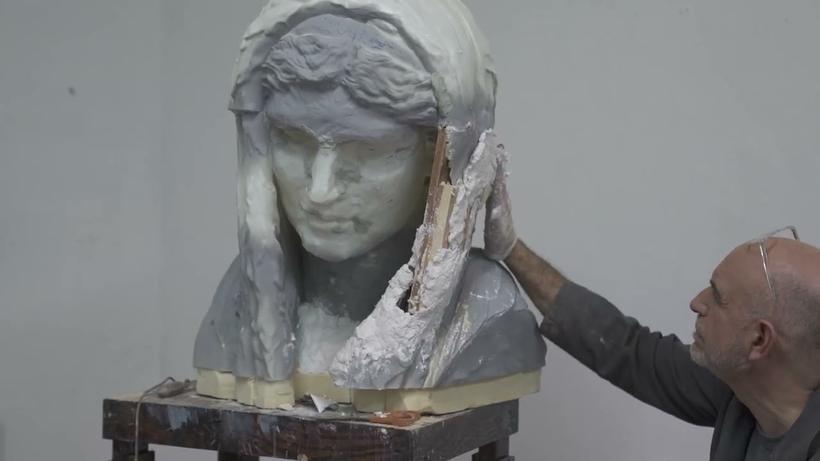
Watch the English-language film on YouTube.
Historical context
Asia Minor Catastrophe · 1920s
Historical chapter from the exhibition catalogue, arranged here for the family story in Sulala.
The 1920s brought a major influx of refugees to Greece, the majority of them from Asia Minor. The region had long been home to many Greek people, including longstanding communities of Cappadocian Greeks and Pontic Greeks. As the Ottoman Empire came to an end, areas of Asia Minor that had been home to tens of thousands of Greeks were annexed by Turkey, and the demographic makeup of many cities within the region were suddenly and inexorably altered. Many of the Orthodox Christians within what is now Turkey, including at least 900,000 people from Asia Minor alone, fled to resettle in mainland Greece, setting off a decade-long refugee crisis.
A major event in this refugee crisis was the destruction of the city Smyrna, which effectively ended the Greco-Turkish War. Before the fire, Smyrna was home to a large Greek community. It was, according to most accounts, a jewel of a city: “Smyrna was a city of a unique cosmopolitan character, full of European travelers and traders, especially during the last decades of the 19th and the early 20th centuries. Turks, Greeks, Jews and Armenians lived together in peace. The Greek community of the city was the largest in population and its members were highly esteemed professionals, working as bankers, traders, lawyers and doctors.”
But the city, as it existed in 1922, would not survive the war. As the city burned, tens of thousands of Greek and Armenian refugees crammed the waterfront to escape from the fire. They were forced to remain there under harsh conditions for nearly two weeks. The number of casualties from the fire is not precisely known; there are differing estimates, some of which place the number of Greeks and Armenians killed as high as 125,000.
Many firsthand accounts of the disaster survive, like this one from Lieutenant A. S. Merrill: “All morning the glow and then the flames of burning Smyrna could be seen. We arrived about an hour before dawn and the scene was indescribable. The entire city was ablaze and the harbor was light as day. Thousands of homeless refugees were surging back and forth on the blistering quay–panic-stricken to the point of insanity. The heartrending shrieks of women and children were painful to hear. In a frenzy they would throw themselves into the water and some would reach the ship. To attempt to land a boat would have been disastrous. Several boats tried and were immediately stopped by the mad rush of a howling mob...The crowds along the quay beyond the fire were so thick and tried so desperately to close abreast the men-of-war anchorage that the masses in the stifling center could not escape except by sea. Fortunately there was a sea breeze and the quay wall never got hot enough to roast these unfortunate people alive, but the heat must have been terrific to have been felt in the ship 200 yards away. To add to the confusion, the packs belonging to these refugees – consisting mostly of carpets and clothing – caught fire, creating a chain of bonfires the length of the street.”
The fire completely destroyed the Greek and Armenian quarters of the city, leading to thousands of people fleeing to Greece to seek safety and a new life. People who had enjoyed life in a cosmopolitan city were suddenly displaced. The famed Onassis family were among the refugees as was the family of my maternal grandmother.
Following the destruction of Smyrna and the end of the Greco-Turkish War, the Convention Concerning the Exchange of Greek and Turkish Populations was signed in Lausanne in January 1923, followed by the peace treaty in July. The convention was an attempt at social engineering that required Orthodox Christians to move to Greece and Muslims to move to Turkey, with specified exemptions, regardless of the language they spoke or the length of time they had been in their current country. The convention affected a vast number of people, an estimated 1.3 million immigrants to Greece and as many as 400,000 immigrants to Turkey. Consequently, both sides of this population exchange suffered traumatic effects. Describing the memory of displacement, Professor Ayse Lahur Kirtunc stated in an interview: "Eighty years have passed, and the memories are warring with another, ripe for distortion. But the core of every migrant's statement remains the same. Birth in one place, growing old in another place. And feeling a stranger in the two places.”
Rebuilding a Life in Greece
Even those migrants from Asia Minor who managed to survive the journey to mainland Greece had a very difficult road ahead of them. Greece was already bearing a massive load of refugees, and the agreed-upon population exchange would further exacerbate issues of resettlement: "The deportations brought significant challenges: social, such as forcibly being removed from one's place of living, and more practical such as abandoning a well-developed family business…Regardless if they settled in urban or rural areas, the vast majority of the refugees arrived in Greece impoverished and often sickly, placing enormous demands on the Greek health care system.” During this period of upheaval, the death rate in refugee communities was four times that of the birth rate.
The United States was instrumental in providing aid to the refugees: “The lives of hundreds of thousands of Greek refugees from Asia Minor, Pontus, and Eastern Thrace were saved thanks to the humanitarian initiatives of American charitable organizations, mainly the American Red Cross and the Near East Relief. These two organizations practically single-handedly undertook the extremely difficult task of providing aid on the spot to Greek refugees who otherwise would have likely been condemned to death by diseases, malnutrition, and other hardships. The gravity of the situation demanded immediate and effective action and the United States was by far the first to respond to the Greek appeals for help. Sometimes the numbers speak for themselves even though they cannot always describe the splendor of philanthropy. The total cost of the relief work undertaken by the American Red Cross for the period from October 1922 to 30 June 1923 amounted to the astonishing $2,605,696.09.”
Despite the initial hurdles, the refugee community would eventually bring much to the economy of Greece by their presence there: “The arrival of the Asia Minor Greeks resulted in the rise of the agricultural production of the state by 400%. The arable land increased by 55%. The Nikolaos Plastiras Government decided on February 14, 1923 to further divide the arable land of Greece, in order for the refugees and their descendants to be the owners of their own land…New industries were established in short time by the skilled refugee population (e.g. carpet industries). In addition, many of them later became successful ship-owners (e.g. Aristotle Onassis).”
Beyond economics, the refugees enriched the cultural landscape of Greece: “New liberal ideas arrived along with the refugees, especially those coming from Smyrna. The influence of the refugees was particularly important in the cultural field.” From the blending of the already existing Greek population with the population of refugees, a new Greek culture was forged, which is still familiar to us today. Important elements of Greek cultural identity like iconic dances (zeibekiko and haspiko) and a cuisine rich in eggplants, tomatoes and spices have their roots in Asia Minor.
Notably, the nation’s most popular sport, soccer, landed in Greece largely because of the refugee population. Some football clubs, like Apollon Smyrnis and Panionios (Greece’s oldest F.C) were transplanted directly from their original homes in Asia Minor. Others, like the popular AEK in Athens and PAOK in Thessaloniki were originally founded by former members of Pera in Constantinople.
It must be acknowledged, however, that these developments were silver linings to what was undoubtedly a period of extreme hardship for over a million people. Because of the scale of the tragedy almost every contemporary Greek family has some historical connection to what many still call The Catastrophe. The Greek writer Dimitris Pentzopoulos wrote, “It is no exaggeration to call the year 1922 the most calamitous in modern Hellenic history.”
Historical images
Sources and reading
- Europeana Blog contributors. (2022, September 14) The Asia Minor Catastrophe. In Europeana. Retrieved January 10, 2024, from https://www.europeana.eu/en/blog/the-asia-minor-catastrophe
- Naimark, Norman M. Fires Of Hatred: Ethnic Cleansing In 20th Century Europe. (Harvard, 2001). p. 50.
- Kaloudis, George "Ethnic Cleansing in Asia Minor and the Treaty of Lausanne" pp. 59–89 from International Journal on World Peace, Volume 31, No. 1, March 2014 p. 83.
- Wikipedia contributors. (2023, December 20). Population exchange between Greece and Turkey. In Wikipedia, The Free Encyclopedia. Retrieved 16:27, December 20, 2023, from https://en.wikipedia.org/w/index.php?title=Population_exchange_between_Greece_and_Turkey&oldid=1190894850
- Klapsis, Antonis. (2011, April). Research Note: American Initiatives for the Relief of Greek Refugees, 1922–1923. From Genocide Studies and Prevention: An International Journal, Volume 6, Issue 1, Article 13.
- Wikipedia contributors. (2023, December 26). Greek refugees. In Wikipedia, The Free Encyclopedia. Retrieved 18:43, January 10, 2024, from https://en.wikipedia.org/w/index.php?title=Greek_refugees&oldid=1191833573
- Wikipedia contributors. (2023, December 26). Greek refugees. In Wikipedia, The Free Encyclopedia. Retrieved 18:43, January 10, 2024, from https://en.wikipedia.org/w/index.php?title=Greek_refugees&oldid=1191833573
- Wikipedia contributors. (2023, November 21). Football in Greece. In Wikipedia, The Free Encyclopedia. Retrieved 16:07, January 17, 2024, from https://en.wikipedia.org/w/index.php?title=Football_in_Greece&oldid=1186245844
- Wikipedia contributors. (2022, June 26). Burning of Smyrna. In Wikipedia, The Free Encyclopedia. Retrieved 16:14, July 20, 2022, from https://en.wikipedia.org/w/index.php?title=Burning_of_Smyrna&oldid=1095063033